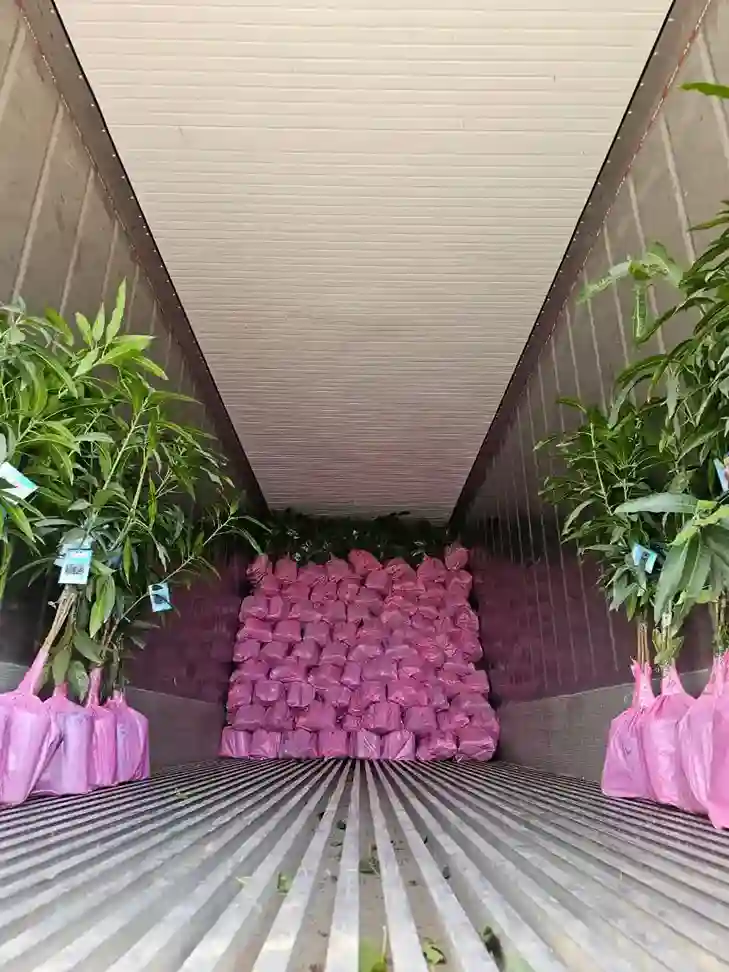
Export Plants from Egypt: International Sourcing of Ornamental Plants and Fruit Seedlings
A Professional Guide for Nurseries, Importers, Landscaping Companies and Commercial Growers
International plant trade is not simply about buying a plant and placing it in a container.
When a nursery in another country needs thousands of plants, when a landscaping company requires hundreds of palms and ornamental trees for a project, or when a commercial farm needs a specific variety of mango, olive, or citrus seedlings, the real challenge is finding a supplier that can manage the entire sourcing process around the buyer’s requirements.
This is where Egypt can become more than a place to purchase plants.
It can become a commercial sourcing base for international plant buyers.
Egypt has a broad agricultural and nursery production sector capable of supplying ornamental plants, landscape plants, palms, trees, and fruit seedlings. More importantly, international buyers do not necessarily have to depend on the stock of one nursery. Through professional sourcing, plants can be identified from suitable production sources across the Egyptian market according to species, variety, size, quantity, and project requirements.
Mashatel Elalamia for Agricultural Supplies operates within this model, combining its own production capabilities with sourcing from selected nurseries, farms, growers, and agricultural suppliers in Egypt.
Our role is therefore not limited to selling what happens to be available in one location.
It begins with a much more important question:
What does the international buyer need?
Egypt as a Sourcing Base for International Plant Buyers
For an international buyer, the value of a plant-supplying country is determined by more than the number of nurseries it has.
A commercially useful sourcing market needs to provide access to:
- Different plant categories
- Commercial quantities
- Multiple varieties
- Different plant sizes
- Different production sources
- Consistent specifications
- Export preparation
- Phytosanitary procedures
- International logistics
- Experienced commercial communication
Egypt offers an agricultural production environment in which these requirements can be addressed across several plant categories.
This is particularly relevant for buyers who are not looking for a single retail plant, but for commercial quantities for nurseries, farms, landscaping projects, garden centers, distributors, hotels, resorts, and agricultural developments.
What Plants Can Be Exported from Egypt?
The international plant-supply market from Egypt can be broadly divided into two major categories:
Ornamental and landscape plants
and
Fruit seedlings and planting material
These categories serve different markets, but both require the same fundamental principle:
The plant must match the buyer’s specifications and the destination country’s requirements.
1. Exporting Ornamental Plants from Egypt
Ornamental plants represent one of the most flexible categories for international sourcing.
They can be required by:
- Landscaping companies
- Hotels and resorts
- Garden centers
- Plant nurseries
- Developers
- Landscape contractors
- Commercial distributors
- Public landscaping projects
- Residential developments
Depending on the project and current availability, sourcing may include indoor and outdoor ornamental plants, palms, flowering plants, tropical plants, shrubs, ornamental trees, and specimen plants.
Among the categories that can be sourced are:
Areca palms
Cycas
Bismarckia
Ficus
Strelitzia
Bougainvillea
Plumeria
Poinciana
Jacaranda
Phoenix palms
Washingtonia
Conocarpus
Ornamental olive trees
and other ornamental and landscape plants according to the buyer’s requirements.
The important point for international buyers is that the supply does not have to be limited to a standard catalogue.
A commercial sourcing request can be built around the actual project.
2. Exporting Fruit Seedlings from Egypt
Egypt is also a relevant sourcing market for fruit seedlings used in commercial orchards, nurseries, agricultural developments, and fruit production projects.
The main categories we focus on include:
Mango seedlings
Olive plants
Citrus seedlings
Additional fruit species can also be investigated according to the requested variety, quantity, specifications, and destination.
For fruit seedlings, the name of the plant alone is not enough.
An international buyer may need to specify:
- Variety
- Propagation method
- Rootstock
- Plant age
- Plant size
- Pot size
- Growing medium
- Quantity
- Production specifications
This is why professional fruit-seedling sourcing is fundamentally different from ordinary plant retail.
Mango Seedlings from Egypt
Mango is one of the most important fruit-seedling categories in our supply program.
International buyers may request commercial varieties such as:
- Keitt
- Kent
- Tommy Atkins
- Osteen
- Naomi
- R2E2
- Crimson
- Maha Chanok
- Sukkari
- Owais
- Zebda
- Timour
- Bazz
- Siddiq
- Red Ivory
Availability depends on the required specification, quantity, production schedule, and current market supply.
For buyers ordering mango seedlings, we recommend providing the required variety, plant age or size, quantity, rootstock requirements, growing medium, and destination before the quotation is prepared.
This gives the sourcing team a clear technical target.
Olive Plants from Egypt
Olive planting material is supplied for both commercial olive-oil production and table-olive cultivation.
Depending on the project, sourcing may include varieties such as:
- Koroneiki
- Coratina
- Arbequina
- Arbosana
- Picual
- Manzanillo
- Kalamata
- Aggezi
- Other requested varieties subject to availability
Olive orders should be treated as variety-specific commercial requirements rather than simply an order for “olive trees.”
The appropriate variety depends on the buyer’s production objective and local growing conditions.
Citrus Seedlings from Egypt
Citrus is another important fruit-seedling category.
International buyers can request citrus plants such as:
- Orange
- Lemon
- Mandarin
- Other citrus varieties
Grafted citrus plants can be sourced according to the required variety and rootstock.
For commercial citrus projects, the buyer should specify the exact variety, rootstock where required, plant size or age, quantity, and destination.
The Advantage of Sourcing Instead of Depending on One Nursery
This is one of the most important differences in the way we approach international plant supply.
A traditional nursery normally begins with its own production.
A professional sourcing company can begin with the buyer’s requirement.
Suppose an international buyer needs:
5,000 mango seedlings
3,000 olive plants
2,000 citrus seedlings
and
several thousand ornamental plants and palms.
The buyer does not necessarily need to find one nursery capable of producing everything.
Instead, the Egyptian market can be searched for suitable production sources for each category.
The different supplies can then be coordinated through one commercial relationship.
This is particularly useful for:
- Large orders
- Mixed plant orders
- Landscaping projects
- New nursery establishment
- Commercial farms
- Garden-center supply
- Distributor requirements
- Long-term sourcing programs
From “What Do You Have?” to “What Do You Need?”
This is the philosophy behind our sourcing model.
An international buyer may approach us with a very specific requirement:
We need a particular mango variety, a particular plant size, a defined quantity, and delivery to a specific country.
Or:
We need several outdoor ornamental species for a landscaping project, with specific sizes and commercial quantities.
Instead of automatically limiting the buyer to what is already available in one nursery, we investigate the Egyptian market for suitable sources.
The process becomes:
Buyer specification
→ Market sourcing
→ Supplier identification
→ Specification and quality review
→ Commercial quotation
→ Supply preparation
→ Export documentation
→ Shipment coordination
This is the difference between simply selling plants and providing an international plant-sourcing service.
Sourcing Plants According to the Buyer’s Specifications
International plant buyers may require much more than a species name.
A proper sourcing request can include:
Species and Variety
The exact botanical or commercial variety required.
Quantity
The number of plants required for the project.
Plant Size
Height, age, trunk diameter, pot size, or another measurable specification.
Rootstock
Especially important for many fruit seedlings.
Production Method
For example, grafted or cutting-propagated plants where relevant.
Growing Medium
The buyer’s required medium or the medium appropriate for export and destination regulations.
Quantity Distribution
For example, several species or varieties within the same shipment.
Destination
Country, port, or final destination as applicable.
Required Timeframe
When the plants are required for shipment or project implementation.
The clearer the specification, the more accurately the Egyptian market can be searched.
Quality in International Plant Trade Starts Before Shipment
For live plants, quality cannot be judged only by photographs or by the price of the quotation.
A commercial buyer needs conformity with the agreed specification.
Depending on the plant category, the sourcing and quality review may consider:
- Correct species
- Correct variety
- Plant size
- Plant age
- General plant condition
- Root development
- Pot size
- Growing medium
- Quantity
- Production consistency
- Suitability for transportation
For large commercial orders, consistency is particularly important.
Receiving 5,000 plants is one thing.
Receiving 5,000 plants that consistently match the agreed specification is what makes the order commercially useful.
Export Preparation for Live Plants
Plants are living products.
Their international transportation therefore requires a different approach from conventional dry cargo.
The shipment must be considered in relation to:
- Plant type
- Plant size
- Root condition
- Growing medium
- Packaging
- Loading arrangement
- Transit time
- Climate and seasonal conditions
- Destination requirements
- Phytosanitary regulations
The appropriate preparation is therefore determined according to the actual shipment rather than applying one method to every plant.
Phytosanitary Certification and Plant Quarantine
International movement of plants is subject to phytosanitary controls designed to manage plant-health risks between countries.
The International Plant Protection Convention provides international standards for phytosanitary measures. ISPM 12 specifically establishes requirements and guidance for the preparation and issuance of phytosanitary certificates for export and re-export.
However, an important point for every importer is that there is no single import procedure that applies to every country.
The importing country’s plant-health authority determines the applicable requirements for the specific commodity and destination.
Depending on the destination and shipment, requirements may concern:
- Import permits
- Phytosanitary certificates
- Plant material
- Growing media
- Inspection
- Quarantine
- Treatments
- Pest-related requirements
- Approved production conditions
- Additional declarations
The international standard itself emphasizes the role of the importing country’s requirements in phytosanitary certification.
This is why we do not approach international plant export with a “one procedure fits all” mindset.
The destination matters.
The plant matters.
The shipment matters.
Export Documentation from Egypt
Depending on the shipment and destination, international plant exports from Egypt may require documentation such as:
Egyptian Certificate of Origin
Phytosanitary Certificate
Agricultural quarantine procedures
and other documents required by the destination country or the specific shipment.
The exact documentation should be determined according to the current requirements applicable to the importing country and plant material.
This distinction is important because an experienced exporter should not promise that the same documents or procedures apply identically to every international market.
Shipping Ornamental Plants and Fruit Seedlings Internationally
The logistics solution depends on the order.
Factors that influence the appropriate shipping method include:
- Destination
- Quantity
- Plant dimensions
- Plant category
- Required transit time
- Seasonal conditions
- Import requirements
- Available transport routes
Depending on the destination and plant material, international shipments may be arranged through land, air, or sea transportation.
For live plants, logistics should always be evaluated as part of the plant-supply process rather than as an unrelated final step.
The objective is to select a practical transportation solution that respects the nature of the living cargo and the requirements of the destination.
Exporting Plants from Egypt to the Gulf
The Gulf region is one of the important international markets for ornamental plants, landscape plants, palms, and fruit seedlings.
Our international supply experience includes markets such as:
United Arab Emirates
Saudi Arabia
Oman
Kuwait
Iraq
Jordan
Lebanon
Each market has its own import requirements, and those requirements must be checked for the specific plant and shipment.
For buyers in the Gulf, our role is to source the requested plants from Egypt, coordinate the supply, prepare the applicable export documentation, and support the shipping process according to the agreed commercial arrangement.
Exporting Plants from Egypt to Africa
Egypt can also serve as a sourcing base for African buyers requiring ornamental plants, fruit seedlings, trees, and landscape material.
Our international supply experience includes African markets such as Uganda.
For African buyers, the appropriate sourcing and transportation model depends heavily on the destination country, route, plant category, quantity, and import requirements.
This makes project-specific sourcing more practical than using a standardized export model for every country.
Exporting Plants from Egypt to Europe
European buyers can also consider Egyptian suppliers for suitable plant categories when the required quality, specifications, phytosanitary conditions, and import regulations can be met.
Our international supply experience includes European markets such as Greece.
For European orders, careful attention should be given to:
- Plant specifications
- Phytosanitary requirements
- Growing media
- Documentation
- Shipment preparation
- Destination regulations
- Transportation time
The objective is not simply to export a plant to Europe.
The objective is to supply a plant that meets the buyer’s agreed specification and the applicable import requirements.
Why International Buyers Work with a Sourcing Company
The international buyer’s problem is often not finding a plant.
The problem is finding the right plant at the required scale.
A sourcing company can help solve several problems simultaneously:
Finding: locating suitable production sources.
Specification: matching plants to the buyer’s technical requirements.
Quantity: investigating commercial availability.
Quality: reviewing available material before shipment.
Coordination: managing communication between the buyer and supply sources.
Documentation: coordinating the applicable export documentation.
Logistics: arranging the shipment according to the agreed commercial terms.
This is particularly valuable when the buyer is outside Egypt and does not have direct access to the local nursery market.
Who Can Source Plants from Egypt?
Our international plant supply service is designed primarily for professional B2B buyers.
International Nurseries
For nurseries looking to expand their product range or purchase plants in commercial quantities.
Plant Importers and Distributors
For companies importing plants for wholesale distribution.
Landscaping Companies
For landscape projects requiring ornamental plants, palms, trees, and shrubs.
Commercial Farms
For farms establishing or expanding orchards with fruit seedlings.
Garden Centers
For businesses requiring wholesale ornamental plants.
Hotels, Resorts and Developers
For projects requiring large quantities of landscape plants.
Agricultural Companies
For commercial planting programs requiring specified varieties and quantities.
What Makes Mashatel Elalamia an International Plant Supply Partner?
Mashatel Elalamia for Agricultural Supplies is an Egypt-based company specializing in plant sourcing, supply, and export for international buyers.
Our business model combines:
Our own production capabilities
with
Sourcing from selected nurseries, farms, growers, and agricultural suppliers in Egypt.
This allows us to work with the buyer’s requirement rather than limiting the project to one nursery’s existing stock.
Our main international supply categories include:
Indoor ornamental plants
Outdoor ornamental plants
Landscape plants
Palm trees
Mango seedlings
Olive plants
Citrus seedlings
and other plants that can be sourced according to the required specifications and destination.
Our international supply experience extends across Gulf, African, and European markets, including previous supply to the United Arab Emirates, Saudi Arabia, Kuwait, Oman, Iraq, Jordan, Lebanon, Greece, and Uganda.
We have also supplied more than 50,000 seedlings to the UAE, including fruit seedlings and ornamental plants.
Our objective is not to present ourselves simply as another nursery.
Our objective is to provide international buyers with a reliable Egyptian sourcing and supply partner.
A Better Way to Source Plants from Egypt
An international buyer does not always need a supplier with the largest catalogue.
The buyer needs a supplier that can understand the requirement and build the supply around it.
That means asking the right questions before discussing price:
What species are required?
Which varieties?
How many plants?
What size?
What rootstock?
What production specification?
What destination?
What import requirements apply?
What shipment method is appropriate?
Once these questions are answered, sourcing becomes a structured commercial process rather than a simple search for a nursery.
Start Your Plant Sourcing Request
If you are an importer, nursery, landscaping company, agricultural business, distributor, garden center, developer, or commercial grower looking for plants from Egypt, send us your requirements.
You can request:
Ornamental plants
Indoor plants
Outdoor plants
Palm trees
Landscape trees
Mango seedlings
Olive plants
Citrus seedlings
or other plants required for your project.
Send us the species, varieties, quantities, sizes, specifications, and destination country.
We will review the requirement and investigate the appropriate sourcing possibilities within the Egyptian market.
Mashatel Elalamia for Agricultural Supplies
International Plant Sourcing & Export from Egypt
Ornamental Plants | Fruit Seedlings | Palms | Landscape Plants
Supplying International B2B Buyers Across Gulf, African and European Markets
Tell us what plants you need. We will investigate the Egyptian market for the right supply.