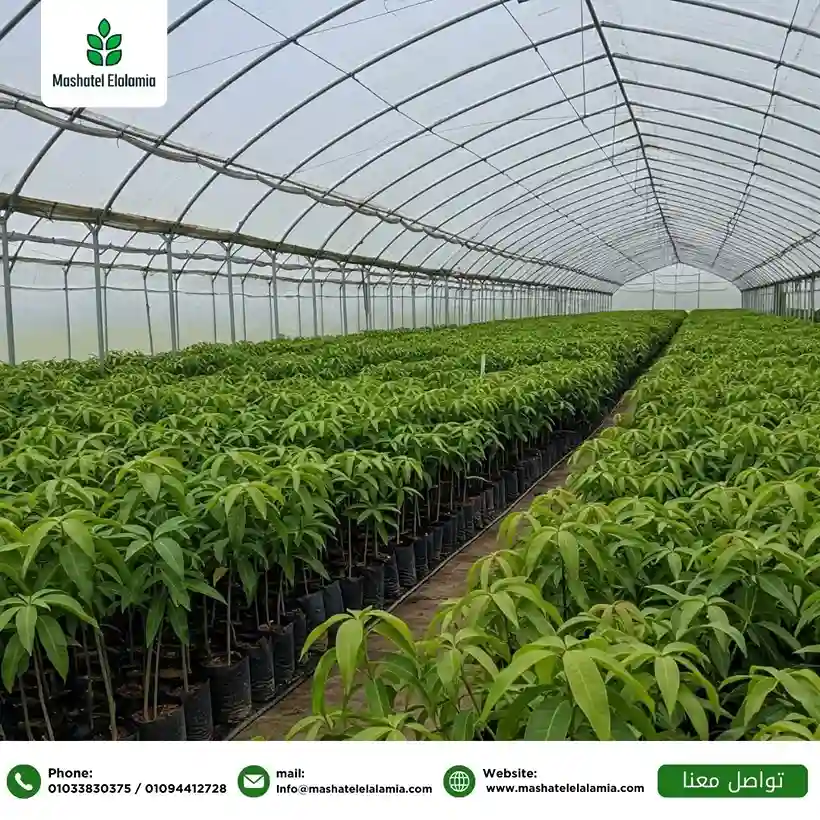
Egypt as a Plant Sourcing Destination: What International Buyers Should Know
When an international nursery, landscaping company, agricultural business, or plant importer starts looking for a new source of live plants, the first question is rarely about one specific plant.
The bigger question is:
Where can we source reliable commercial quantities of plants at the specifications our market requires?
For buyers considering North Africa and the Middle East, Egypt deserves to be considered as a serious plant-sourcing market.
Egypt has a substantial agricultural production base, a large nursery sector, a wide range of ornamental and fruit plants, and access to production from multiple growing operations.
This creates an opportunity that is particularly relevant to professional buyers:
Instead of searching for one nursery with everything in stock, an international buyer can use Egypt as a broader sourcing market.
That distinction is important.
Egypt Is More Than a Nursery Market
International buyers sometimes approach plant sourcing as though they are buying from a single catalogue.
That approach can work for small orders.
It becomes much less practical when a buyer needs:
- Several plant species
- Specific varieties
- Large quantities
- Different plant sizes
- Fruit seedlings and ornamentals in the same order
- Specific production specifications
- Plants for a commercial project
- Regular future supply
A broader sourcing market provides another option.
Egypt has a network of nurseries, farms, growers, and agricultural suppliers producing different categories of plants.
For an international buyer, this means that the search does not necessarily have to begin with:
“Which nursery has this plant?”
It can begin with:
“Where in the Egyptian market can we source this specification?”
That is the foundation of professional plant sourcing.
What Makes the Egyptian Market Relevant to International Plant Buyers?
The strength of Egypt as a sourcing market comes from the combination of several factors rather than one single advantage.
A Broad Agricultural Production Base
Egypt has extensive agricultural activity covering fruit crops, ornamental plants, trees, palms, and landscape plants.
This creates access to different types of plant material through different production sources.
Product Diversity
A buyer looking for ornamental plants does not necessarily have to work with the same supplier as a buyer looking for fruit seedlings.
Different production specialists can serve different requirements.
A sourcing company can connect these requirements within one purchasing process.
Commercial Quantities
International B2B buyers are often interested in quantities that are significantly larger than normal retail purchases.
The Egyptian production market can therefore be approached as a commercial sourcing base for wholesale requirements.
Geographic Position
Egypt sits between several important regions, including Europe, Africa, the Middle East, and Asia.
The practical shipping route and cost will always depend on the destination and product, but Egypt’s location makes it relevant to buyers across multiple regions.
What Types of Plants Can Be Sourced from Egypt?
The Egyptian market can support sourcing across several major plant categories.
Ornamental Plants
This is one of the most diverse categories.
International buyers may look for:
- Indoor ornamental plants
- Outdoor ornamental plants
- Flowering plants
- Tropical plants
- Ornamental shrubs
- Ornamental trees
- Palms
- Landscape plants
- Specimen plants
Species and availability vary according to season, production source, size, and quantity.
For this reason, professional sourcing should begin with the buyer’s specification rather than a generic product list.
Fruit Seedlings
Fruit seedlings represent another major commercial category.
Among the most important are:
Mango
Egyptian production can provide several commercial mango varieties, including Keitt, Kent, Tommy Atkins, Osteen, Naomi, R2E2, Crimson, Maha Chanok, Sukkari, Owais, Zebda, Timour, Bazz, Siddiq, and Red Ivory, subject to availability and required specifications.
Olive
International buyers can source olive plants for oil production and table olive cultivation, including varieties such as Koroneiki, Coratina, Arbequina, Arbosana, Picual, Manzanillo, Kalamata, and Aggezi, subject to availability.
Citrus
The category includes citrus seedlings such as orange, lemon, mandarin, and other requested citrus varieties.
Grafted plants can be sourced according to variety, rootstock, size, quantity, and project requirements.
Why a Buyer May Need a Plant Sourcing Company
Imagine a buyer needs:
10,000 mango seedlings
plus
5,000 olive plants
plus
3,000 ornamental palms
plus
several thousand outdoor ornamental plants.
The buyer could approach several nurseries independently.
That creates several purchasing relationships, different quotations, different quality standards, different production schedules, and potentially different export arrangements.
A sourcing company can instead investigate the Egyptian market on behalf of the buyer and coordinate the required supply.
The value is therefore not simply “having plants.”
The value is finding the right plants and coordinating the supply chain around the buyer’s requirements.
The Difference Between a Nursery and a Sourcing-Based Supplier
A nursery normally starts with its own production.
A sourcing-based supplier starts with the buyer’s requirement.
That difference becomes important when the buyer requests a plant that is:
- Not currently in stock
- Required in a large quantity
- Needed in a specific size
- Needed in a particular variety
- Required together with several other species
- Needed according to a project schedule
At Mashatel Elalamia for Agricultural Supplies, our business model combines our own plant production with sourcing through selected nurseries, farms, growers, and agricultural suppliers in Egypt.
This gives international buyers another route:
Tell us what you need first.
We then investigate the appropriate sourcing possibilities.
What Should an International Buyer Specify?
A serious plant-sourcing inquiry should contain enough technical information to identify the correct product.
For example:
Species
Mango, olive, citrus, palm, ornamental plant, landscape tree, or another plant.
Variety
The exact cultivar where applicable.
Quantity
The total number of plants required.
Size
Plant height, age, trunk diameter, pot size, or another relevant measurement.
Rootstock
Important for many fruit seedlings.
Growing Medium
The required production or export medium where applicable.
Destination
The importing country and preferred destination point.
Timing
When the buyer expects the plants to be ready or delivered.
The more precise the request, the more useful the sourcing process becomes.
Sourcing Is Not the Same as Simply Comparing Prices
Price is naturally important in international plant trade.
But price alone cannot determine whether a shipment is commercially successful.
A buyer should also consider:
Does the plant match the requested variety?
Is the plant size consistent?
Is the quantity actually available?
Can the plants be prepared for the required transport method?
Can the supplier coordinate the necessary export documentation?
Does the shipment comply with the destination country’s requirements?
Can the supplier maintain the required specifications for future orders?
A professional plant supplier should therefore be evaluated on the complete supply process rather than on the lowest quotation alone.
Quality Begins Before the Plants Are Loaded
For live plants, quality control should not start when the shipment arrives.
It starts at sourcing.
The selected plants should be evaluated against the specifications agreed with the buyer.
Depending on the plant category, this may involve checking:
- Variety
- Plant size
- Age
- General plant condition
- Root system
- Pot size
- Growing medium
- Quantity
- Production method
- Loading suitability
The exact criteria depend on the product and destination.
This is particularly important for buyers ordering commercial quantities because inconsistency across a large shipment can create problems after arrival.
Exporting Live Plants Requires Destination Awareness
There is no single international plant-import procedure that applies to every country.
Requirements can vary according to:
- Country
- Plant species
- Plant material
- Growing medium
- Plant size
- Shipment method
- Agricultural quarantine regulations
The buyer should therefore establish the destination country’s import requirements before finalizing the order.
On the Egyptian side, international shipments may require export and agricultural documentation such as a Certificate of Origin and Phytosanitary Certificate, together with applicable agricultural quarantine procedures.
The exact documentation should always be confirmed for the specific shipment and destination.
From Egypt to the Gulf, Africa and Europe
Egyptian plants can be considered by buyers across several international regions.
Gulf Markets
The Gulf is an important market for ornamental plants, landscaping material, palms, fruit seedlings, and agricultural plants.
The specific import requirements vary by country.
Mashatel Elalamia has supplied international buyers in markets including the United Arab Emirates, Saudi Arabia, Kuwait, Oman, Iraq, Jordan, and Lebanon.
African Markets
African markets can also provide opportunities for Egyptian plant sourcing, particularly for ornamental plants, landscape material, and fruit seedlings.
Our international supply experience includes African markets such as Uganda.
European Markets
European buyers may also consider Egyptian suppliers for selected plant categories where the plant specifications, quality, phytosanitary requirements, and logistics are appropriate.
Mashatel Elalamia has also supplied to European markets, including Greece.
The suitability of Egypt as a source should always be evaluated according to the specific plant and the importing country’s regulations.
When Egypt May Be the Right Sourcing Choice
Egypt can be particularly relevant when a buyer is looking for:
- Commercial quantities
- Multiple plant categories
- Fruit seedlings
- Ornamental plants
- Landscape plants
- Palms and trees
- Different varieties
- Flexible sourcing options
- A supplier able to investigate the wider Egyptian market
It is not necessary for every international buyer to source every plant from one country.
The correct approach is to compare the available source markets based on:
Plant quality + availability + specifications + total landed cost + logistics + import requirements.
Egypt should be considered within that evaluation.
A Practical Model for Buying Plants from Egypt
A professional sourcing process can be organized into several stages.
Step 1 — Buyer Specification
The buyer provides the required plants, varieties, quantities, sizes, destination, and timing.
Step 2 — Egyptian Market Sourcing
The supplier investigates appropriate production sources.
Step 3 — Availability and Specification Review
Available plants are evaluated against the buyer’s requirements.
Step 4 — Commercial Offer
The buyer receives the applicable quotation and supply conditions.
Step 5 — Confirmation
Specifications, quantities, commercial terms, and shipment requirements are confirmed.
Step 6 — Export Preparation
The plants are prepared according to the agreed shipment and destination requirements.
Step 7 — Documentation and Shipment
The applicable export and phytosanitary documents are prepared and the shipment is coordinated.
Step 8 — Destination Clearance
The importer completes the destination-country procedures according to local regulations.
This workflow gives both sides a clearer understanding of their responsibilities.
What Makes Mashatel Elalamia Different?
Mashatel Elalamia for Agricultural Supplies is not positioned simply as a local nursery selling plants from existing stock.
We operate as an Egyptian plant sourcing and supply company for international buyers.
Our production capabilities cover selected plant categories, while our access to surrounding nurseries, farms, growers, and agricultural suppliers allows us to investigate additional plants and quantities according to customer requirements.
This means our starting point is not always:
“What do we have?”
It can be:
“What does the buyer need?”
From there, we investigate the Egyptian market and work to identify suitable plants according to the requested specifications.
Our international supply experience extends across Gulf, African, and European markets, including previous supply activity to countries such as the UAE, Saudi Arabia, Kuwait, Oman, Iraq, Jordan, Lebanon, Greece, and Uganda.
A Better Way to Think About Importing Plants from Egypt
For an international buyer, Egypt should not be viewed simply as a country where individual nurseries sell plants.
It can be viewed as a plant sourcing market.
The difference is significant.
A nursery offers what it produces.
A sourcing-based supplier searches the market for what the buyer needs.
For commercial buyers, this can be especially valuable when the order involves several species, specific varieties, substantial quantities, or project-based specifications.
Start with Your Requirement
If you are considering Egypt as a source for your next plant order, you do not need to start with a generic product catalogue.
Start with your requirement.
Tell us:
What plant do you need?
Which variety?
How many plants?
What size or specification?
Where will the plants be imported?
When do you need them?
Mashatel Elalamia can then investigate suitable sourcing options in the Egyptian market and determine what can be supplied according to your requirements.
Mashatel Elalamia for Agricultural Supplies
International Plant Sourcing & Supply from Egypt
Ornamental Plants | Fruit Seedlings | Palms | Landscape Plants
Serving International B2B Buyers
[Request a Quote]